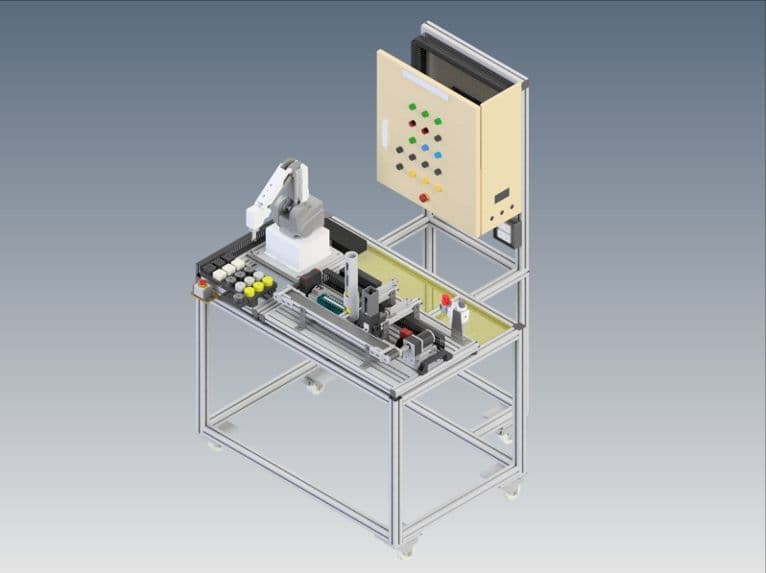



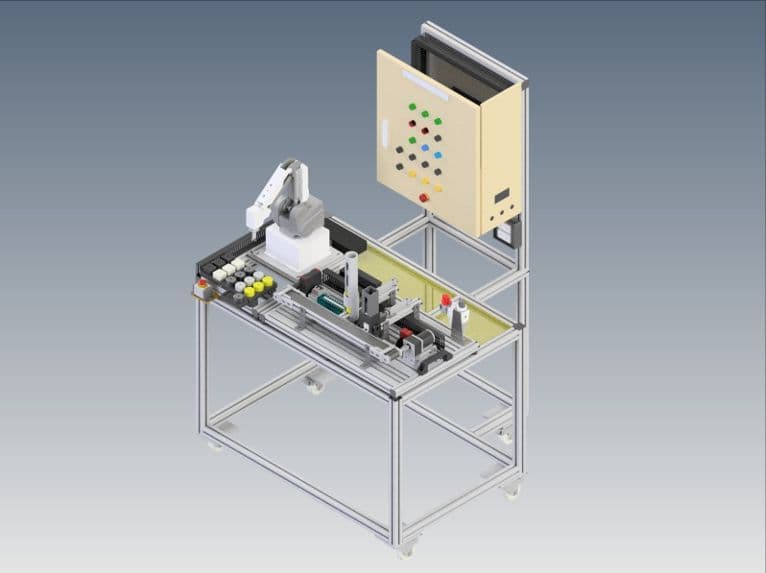
This Project has been undertaken to address the need for skill development and knowledge enhancement in pneumatic systems and automation control, which are crucial in today’s manufacturing industry. Pneumatic systems play a vital role in various production processes, including machine control, automated devices, and assembly lines. However, the Department of Measurement and Control Engineering currently lacks a laboratory dedicated to the study and experimentation of pneumatic systems due to the deterioration and lack of maintenance of the previously used equipment. This has resulted in students missing the opportunity to practice essential skills required in the industrial sector. The authors of this thesis recognize the necessity of reviving and developing a pneumatic laboratory that can effectively support teaching, learning, and research activities. This project focuses on studying and developing industrial robotic arm control systems and pneumatic systems, integrating modern technologies such as Programmable Logic Controllers (PLC) and AI Vision. These systems are intended to be applicable to real-world industrial contexts. The outcomes of this project are expected to not only enhance the understanding of relevant technologies but also aim to transform the laboratory into a vital learning hub for current and future students. Furthermore, this initiative seeks to improve the competitiveness of students in the job market and support the development of innovations in the manufacturing industry in the years to come.
จากการศึกษาและประสบการณ์ในการฝึกงานของคณะผู้จัดทำ พบว่าระบบนิวเมติกส์และ PLC เป็นองค์ประกอบสำคัญในระบบอุตสาหกรรมยุคใหม่ โดยช่วยควบคุมและเพิ่มประสิทธิภาพในสายการผลิต ในอนาคตเทคโนโลยี AI Vision จะเข้ามามีบทบาทสำคัญในการพัฒนาอุตสาหกรรมการผลิต ด้วยความสามารถในการตรวจจับ วิเคราะห์ และประมวลผลข้อมูลภาพอย่างแม่นยำ ช่วยเพิ่มความแม่นยำในการควบคุมคุณภาพผลิตภัณฑ์ ลดข้อผิดพลาดในการผลิต และเพิ่มความสามารถในการปรับตัวให้เข้ากับกระบวนการที่ซับซ้อนมากขึ้น AI Vision สามารถใช้ในอุตสาหกรรมเพื่อตรวจสอบข้อบกพร่องของผลิตภัณฑ์แบบเรียลไทม์ วิเคราะห์ข้อมูลเพื่อเพิ่มประสิทธิภาพการผลิต และช่วยให้ระบบอัตโนมัติสามารถเรียนรู้และพัฒนาได้อย่างต่อเนื่อง โดยผสานกับ PLC และระบบนิวเมติกส์เพื่อให้เกิดความแม่นยำและการตอบสนองที่รวดเร็ว นอกจากนี้ AI Vision ยังสามารถพัฒนาไปสู่การตรวจสอบกระบวนการผลิตแบบอัจฉริยะ ช่วยลดต้นทุนในการดำเนินงาน และเพิ่มขีดความสามารถในการแข่งขันของภาคอุตสาหกรรมในอนาคต

คณะวิศวกรรมศาสตร์
Design and Development of a Remote Battery Management System This research focuses on the design and development of a battery management system that enables remote monitoring and control, allowing users to customize battery cell properties as needed. The system is specifically designed for use with graphene battery cells and can be effectively applied to alternative energy systems for residential use.

คณะอุตสาหกรรมอาหาร
Bio-calcium powders were extracted from Asian sea bass bone by heat-treated alkaline with fat removal and bleaching supplementary method. Cereal bars (CBs) were fortified with produced bio-calcium at 3 levels: (1) increased calcium (IS-Ca; calcium ≥10% Thai RDI), (2) good source of calcium (GS-Ca; calcium ≥15% Thai RDI), and (3) high calcium (H-Ca; calcium ≥30% Thai RDI) which were consistent with the notification of the Ministry of Public Health, Thailand: No. 445; Nutrition claim issued in B.E. 2023. Moisture content, water activity, color, calcium content and FTIR analysis of bio-calcium powders were measured. Dimension, color, water activity, pH and texture of fortified CBs were determined. Produced bio-calcium could be classified as a dried food with light yellow-white color. Calcium contents in bio-calcium powder was 23.4% (w/w). Dimension, weight and color except b* and ΔE* values of fortified CBs were not different (P > 0.05) from those of the control. Fortifying of bio-calcium resulted in harder texture CBs. An increase of fortified bio-calcium amounts decreased carbohydrate and fat but increased of protein, ash and calcium in the fortified CBs. Shelf life of CBs was to be shorten by fortification of bio-calcium powder because of the increment of moisture, water activity and pH. Yield of bio-calcium production was 40.30%. Production cost of bio-calcium was approximately 7,416 Bth/kg while cost of fortified CBs increased almost 2-3 times compared to the control. Calcium contents in IS-Ca (921.12 mg/100g), GS-Ca (1,287.10 mg/100g) and H-Ca (2,639.70 mg/100g) cereal bars could be claimed as increased calcium, good source of calcium and high calcium, respectively. In conclusion, production of cereal bar fortified with Asian sea bass bone bio-calcium powder as a fortified food was possible. However, checking the remained hazardous reagents in bio-calcium powder must be carried out before using in food products and analysis of calcium bioavailability, sensory acceptance and shelf life of the developed products should be determined in further studies.

คณะอุตสาหกรรมอาหาร
The Ginbanirose project aims to develop herbal extracts for alleviating menstrual pain using key ingredients: roselle, banana inflorescence, and ginger. These ingredients contain bioactive compounds with anti-inflammatory, antioxidant, and pain-relieving properties. The extracts are enhanced through liposome encapsulation technology, which improves absorption and stability. The production process involves herbal extraction, freeze-drying, and liposome formulation using lecithin and stabilizers. Experimental results demonstrate high phenolic content and antioxidant activity via the DPPH method. Ginbanirose addresses women’s quality of life concerns while offering significant business opportunities in the rapidly growing herbal market, particularly in the Asia-Pacific region.