



KMITL Expo 2026 LogoKMITL 66th Anniversary Logo

il n'y a rien à faire

Abstract

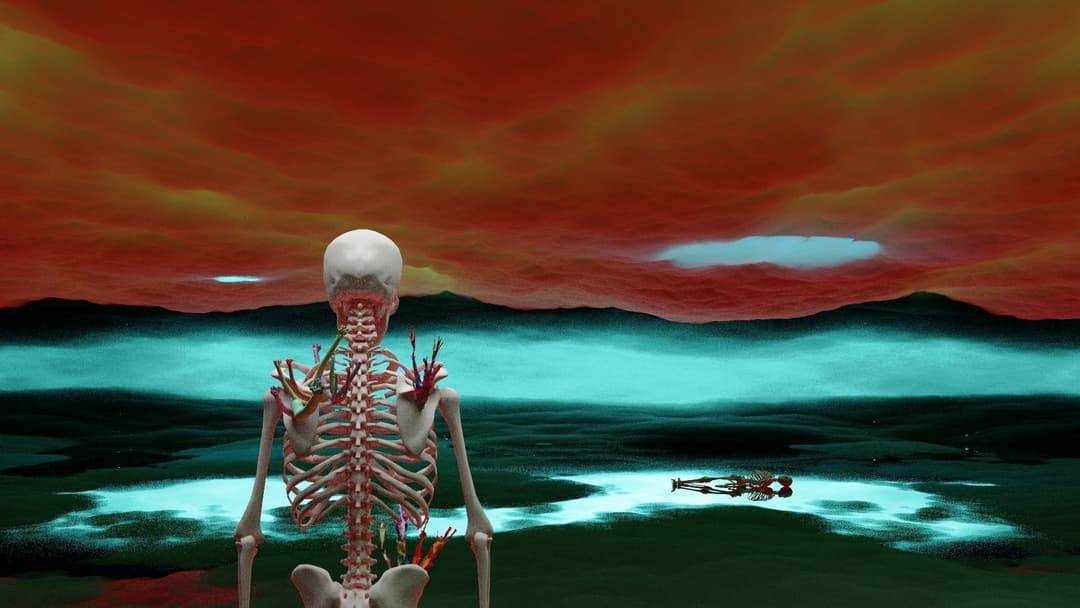
This artwork was created based on the universal concepts of global warming and post-apocalyptic world, which has caused disturbances and chaos in ecosystems, leading to the extinction of many living beings on Earth due to human actions. Repairing and restoring this world may therefore be a false hope, connected to my personal experience of losing loved ones and the sorrow from setting high hope, through the artistic process using Animation Art and Sound Art.
Objective

ข้าพเจ้าต้องการแสดงถึงปัญหาและสิ่งที่มนุษย์ได้ทิ้งเศษซากไว้ให้ผู้อื่นรับผลกระทบแทนตน เพื่อให้ตระหนักรู้ถึงความสำคัญในการเปลี่ยนแปลงการดำรงชีวิต เพื่อการดำรงอยู่ของสิ่งมีชีวิตทั่วโลก และข้าพเจ้าได้เชื่อมโยงประสบการณ์ส่วนตัวลงไปเพื่อเป็นการแสดงความรู้สึกร่วมซึ่งล้วนเป็นความทุกข์ออกไปให้ผู้อื่นได้รับทราบไม่มากก็น้อยเพื่อแบ่งเบาความทุกข์นี้ไปจากข้าพเจ้า

Other Innovations

Application of hydro priming technique with water plasma to the germination quality of riceberry.

คณะเทคโนโลยีการเกษตร

Application of hydro priming technique with water plasma to the germination quality of riceberry.

การทดลองนี้จึงมีวัตถุประสงค์เพื่อศึกษาผลของน้ำที่ผ่านการฉายพลาสมาในเวลาที่แตกต่างกันต่อคุณภาพการงอกของเมล็ดพันธุ์ข้าวไรซ์เบอรี่ เพื่อเป็นการยกระดับคุณภาพความงอกของเมล็ดพันธุ์ข้าวไรซ์เบอรี่

Read more
A Unified Framework for Automated Captioning and Damage Segmentation in Car Damage Analysis

คณะเทคโนโลยีสารสนเทศ

A Unified Framework for Automated Captioning and Damage Segmentation in Car Damage Analysis

This research presents a deep learning method for generating automatic captions from the segmentation of car part damage. It analyzes car images using a Unified Framework to accurately and quickly identify and describe the damage. The development is based on the research "GRiT: A Generative Region-to-text Transformer for Object Understanding," which has been adapted for car image analysis. The improvement aims to make the model generate precise descriptions for different areas of the car, from damaged parts to identifying various components. The researchers focuses on developing deep learning techniques for automatic caption generation and damage segmentation in car damage analysis. The aim is to enable precise identification and description of damages on vehicles, there by increasing speed and reducing the work load of experts in damage assessment. Traditionally, damage assessment relies solely on expert evaluations, which are costly and time-consuming. To address this issue, we propose utilizing data generation for training, automatic caption creation, and damage segmentation using an integrated framework. The researchers created a new dataset from CarDD, which is specifically designed for cardamage detection. This dataset includes labeled damages on vehicles, and the researchers have used it to feed into models for segmenting car parts and accurately labeling each part and damage category. Preliminary results from the model demonstrate its capability in automatic caption generation and damage segmentation for car damage analysis to be satisfactory. With these results, the model serves as an essential foundation for future development. This advancement aims not only to enhance performance in damage segmentation and caption generation but also to improve the model’s adaptability to a diversity of damages occurring on various surfaces and parts of vehicles. This will allow the system to be applied more broadly to different vehicle types and conditions of damage inthe future

Read more
Co-fermentation of lactic acid bacteria and Saccharomyces cerevisiae to produce sour beer

คณะอุตสาหกรรมอาหาร

Co-fermentation of lactic acid bacteria and Saccharomyces cerevisiae to produce sour beer

This study aims to investigate the co-fermentation process between lactic acid bacteria (LAB) and Saccharomyces cerevisiae in the production of sour beer, with a focus on its impact on product quality, including pH, organic acid content, sugar content, and sensory characteristics. In this experiment, selected LAB strains and S. cerevisiae were utilized under controlled fermentation conditions. The microbial ratio was optimized to enhance growth and the production of key compounds. The findings indicate that co-fermentation significantly reduces pH compared to fermentation with yeast alone. Furthermore, an increase in lactic acid was observed due to sugar consumption by LAB, contributing to the distinctive flavor profile of sour beer.

Read more