


KMITL Expo 2026 LogoKMITL 66th Anniversary Logo

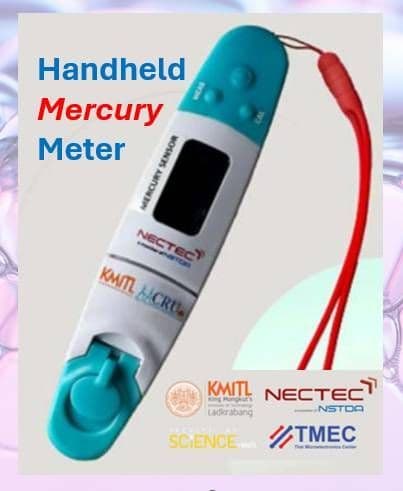
Handheld Mercury Meter

Handheld Mercury Meter

Abstract

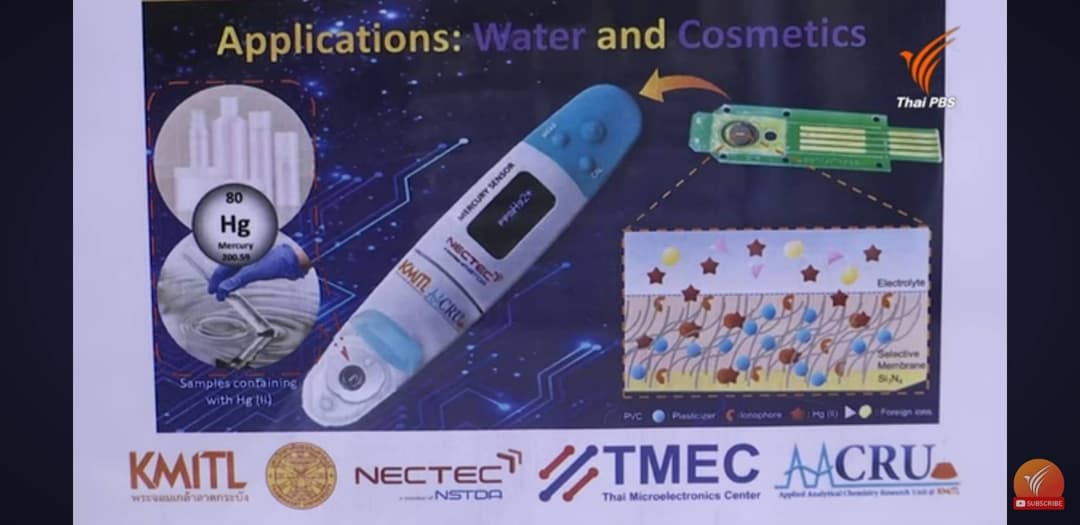
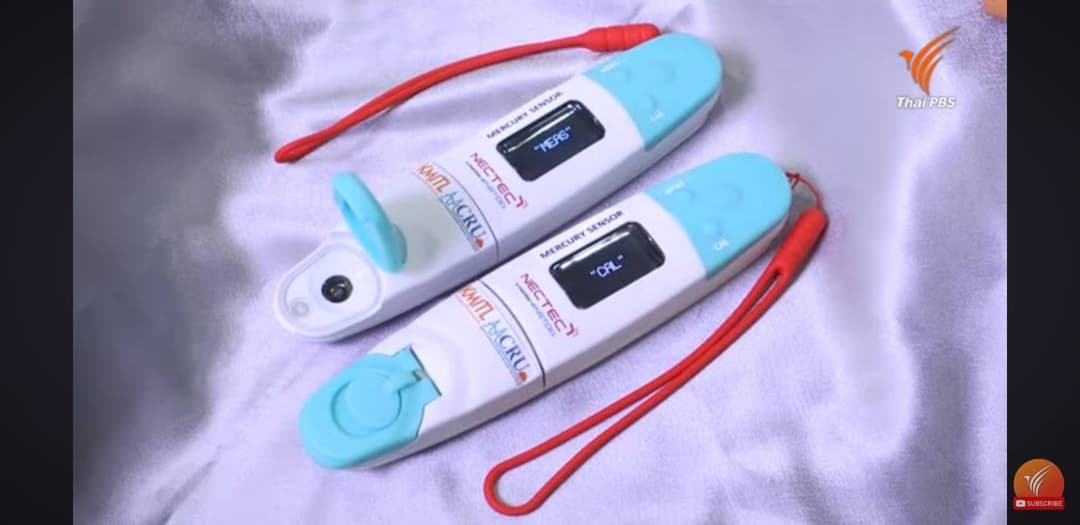
This work presents the fabrication of the handheld meter for potentiometric detection of Hg (II). The meter was constructed based on using an ion-sensitive field-effect transistor (ISFET) platform. The developed meter provides high accuracy and precision (%Recovery was in the range of 92.55 - 109.32 and %RSD was 2.38). It was applied to the analysis of cosmetic samples. The results by the developed electrode were not significantly different at a 95% confidence level compared to the results by using ICP-OES.
Objective

‘ปรอท’ เป็นโลหะหนักชนิดหนึ่งและเป็นโลหะเพียงชนิดเดียวที่ในรูปบริสุทธิ์จะอยู่ในสถานะของเหลวที่อุณหภูมิห้อง มีสีคล้ายเงิน ปรอทนำไปใช้ประโยชน์ในภาคอุตสาหกรรมอย่างกว้างขวาง เช่น อุปกรณ์อิเล็กทรอนิกส์ เป็นต้น ซึ่งน้ำเสียที่เกิดจากภาคอุตสาหกรรมเหล่านี้ จะต้องได้รับการบำบัดก่อนปล่อยสู่แหล่งน้ำ เพื่อป้องกันไม่ให้เกิดการปนเปื้อนของปรอท เนื่องจากปรอทเป็นโลหะหนักที่มีความเป็นพิษสูงมาก ซึ่งมีทั้งชนิดเฉียบพลันและเรื้อรัง อย่างไรก็ดี หากภาคอุตสาหกรรม มีระบบบำบัดน้ำเสียที่ไม่มีคุณภาพและไม่ได้มาตรฐาน อาจทำให้เกิดการรั่วไหลและปนเปื้อนของน้ำเสียที่มีปรอทเจือปนสู่แหล่งน้ำธรรมชาติได้ ดังนั้นจึงจำเป็นต้องมีการเฝ้าระวังปริมาณปรอทในแหล่งน้ำธรรมชาติอย่างจริงจัง ซึ่งกรมควบคุมมลพิษได้กำหนดเกณฑ์มาตรฐานคุณภาพน้ำให้มีปริมาณปรอททั้งหมดมีค่าสูงสุดอยู่ที่ 0.002 และ 0.005 มิลลิกรัมต่อลิตร (ppm) สำหรับน้ำผิวดิน และ น้ำทิ้งจากโรงงานอุตสาหกรรมและนิคมอุตสาหกรรม ตามลำดับ อีกทั้งยังมีใช้ปรอทในเครื่องสำอางด้วย เนื่องจากสารประกอบของปรอทมีคุณสมบัติช่วยให้สีผิวขาวขึ้นและป้องกันสิวได้ด้วย แต่ถ้าใช้งานในปริมาณมากก็จะเกิดผลเสียคือปรอททำให้เกิดการแพ้ ผื่นแดง ผิวบางลง และเมื่อใช้ติดต่อกัน เป็นเวลานานจะทำให้เกิดพิษสะสมของสารปรอทในผิวหนัง และดูดซึมเข้าสู่กระแสโลหิตได้ จึงทำให้กระทรวงสาธารณสุขได้กำหนดเกณฑ์วัตถุที่ห้ามใช้เป็นส่วนผสมในการผลิตเครื่องสำอาง ให้มีปริมาณปรอททั้งหมดปนเปื้อนในผลิตภัณฑ์สำเร็จรูป ได้ไม่เกิน 1 มิลลิกรัมต่อลิตร (ppm) โดยถ้ามีปริมาณปรอทเกินกำหนดเกณฑ์มาตรฐาน ทั้งในแหล่งน้ำและในผลิตภัณฑ์เครื่องสำอาง ผู้ประกอบการอุตสาหกรรมนั้นจะมีความผิดและต้องรับโทษทางกฎหมาย เพื่อเป็นการป้องกันไม่ให้เกิดภัยร้ายแรงต่อสิ่งแวดล้อม รวมถึงมนุษย์และสัตว์ต่าง ๆ ด้วย ในปัจจุบัน วิธี Cold vapor atomic absorption spectrometer (CV-AAS) จัดเป็นวิธีมาตรฐานสำหรับตรวจวัดหาปริมาณปรอท วิธีนี้มีข้อดี คือให้ผลการวิเคราะห์ที่ถูกต้องและแม่นยำ แต่มีข้อเสีย คือเป็นเครื่องมือขั้นสูง มีขนาดใหญ่ ราคาแพง ใช้เวลานานกว่าจะรู้ผล และไม่สามารถทำการทดสอบนอกห้องปฏิบัติการได้ ดังนั้นจึงจำเป็นต้องมีการพัฒนาวิธีตรวจวัดปริมาณปรอทที่ทำการตรวจวัดได้ง่าย ให้ผลการวิเคราะห์ที่รวดเร็ว และงบประมาณในการวิเคราะห์ไม่สูงมากนัก ในงานวิจัยนี้ จึงมีความมุ่งหวังจะพัฒนาขั้วไฟฟ้าขนาดเล็กที่ตรวจวัดปรอทได้อย่างจำเพาะเจาะจงสำหรับหาปริมาณปรอทในแหล่งน้ำและในเครื่องสำอาง ณ ที่ทำการตรวจวัด (On-site analysis) ได้ หรืออาจใช้ตรวจวัดในห้องปฏิบัติการทดแทนการใช้เครื่องวิเคราะห์ขนาดใหญ่ก็ได้เช่นกัน โดยในการสร้างขั้วไฟฟ้าจะตรึงเซนเซอร์ทางเคมี (Molecular sensor) ที่ทำการสังเคราะห์ขึ้นเองลงบน Ion-sensitive field-effect transistor (ISFET) หลักการตรวจวัดอาศัยการทำปฏิกิริยาอย่างจำเพาะเจาะจงระหว่างไอออนปรอท (Hg (II)) กับเซนเซอร์ทางเคมีดังกล่าว ทำให้เกิดการเปลี่ยนสัญญาณไฟฟ้าที่ขั้ว ISFET และสัญญาณไฟฟ้านี้จะแปรผันกับความเข้มข้นของ Hg (II) ทำให้สามารถวิเคราะห์เชิงปริมาณได้ จากนั้นทำการทดสอบความจำเพาะเจาะจงของเซนเซอร์ต่อปรอท และประยุกต์ใช้เซนเซอร์ที่พัฒนาขึ้นกับตัวอย่างจริง รวมถึงจะทำการทดสอบความถูกต้องของวิธีที่พัฒนาขึ้นต่อไป

Other Innovations

A Comparison of The Performance of Machine Learning Methods on Time Series Data Using Lagged Time Intervals

คณะวิทยาศาสตร์

A Comparison of The Performance of Machine Learning Methods on Time Series Data Using Lagged Time Intervals

This special problem aims to compare the performance of machine learning methods in time series forecasting using lagged time periods as independent variables. The lagged periods are categorized into three groups: lagged by 10 units, lagged by 15 units, and lagged by 20 units. The study employs four machine learning methods: Decision Tree (DT), Random Forest (RF), K-Nearest Neighbors (KNN), and Support Vector Machine (SVM). The time series data simulated as independent variables diverse including characteristics: Random Walk data, Trending data, and Non-Linear data, with sample sizes of 100, 300, 500, and 700. The research methodology involves splitting the data into 90% for training and 10% for testing. Simulations and analysis are performed using the R programming language, with 1,000 iterations conducted. The results are evaluated based on the average mean squared error (AMSE) and the average mean absolute percentage error (AMAPE) are calculated to identify the best performing method. The research findings revealed that for Random Walk data, the best performing methods are Random Forest and Support Vector Machine. For Trend data, the best performing methods are Random Forest. For Non-Linear data, the best performing methods are Support Vector Machine. When tested with real-world data, the results show that for the Euro-to-Thai Baht exchange rate, the best methods are Random Forest and Support Vector Machine. For the S&P 500 Index in USD, the best performing methods are Random Forest. For the Bank of America Corp Index in USD, the best performing methods are Support Vector Machine.

Read more
OPTIMIZATION OF CONCENTRATED BUTTERFLY PEA EXTRACT PROCESS

คณะวิศวกรรมศาสตร์

OPTIMIZATION OF CONCENTRATED BUTTERFLY PEA EXTRACT PROCESS

This thesis project was conducted to identify the optimal conditions for producing concentrated butterfly pea juice using vacuum evaporation to preserve key compounds in butterfly pea flowers, such as anthocyanins—natural pigments with high antioxidant properties. The study applies a Box-Behnken Design, a statistical method that facilitates analysis of multiple factors. The research focuses on the ratio of dried butterfly pea flowers to water, extraction temperature, and evaporation temperature, each of which has a direct effect on the preservation of key compounds, color, aroma, and flavor. The results indicate that using a dried flower-to-water ratio of 1:15, an extraction temperature of 60°C, and an evaporation temperature of 40°C under low pressure can minimize the loss of essential compounds and best retain the properties of the concentrated butterfly pea juice. Findings from this research provide a foundation for developing an industrial production process for concentrated butterfly pea juice and enhance the potential for creating new products from butterfly pea flowers.

Read more
Synergistic antibacterial activity of human salivary peptide Histatin-5 and Phytosphingosine against Streptococcus mutans biofilm

คณะทันตแพทยศาสตร์

Synergistic antibacterial activity of human salivary peptide Histatin-5 and Phytosphingosine against Streptococcus mutans biofilm

Objective or Background: Dental caries is still one of the most significant dental problems worldwide, with prevalence rates up to 90% among children and adults. Cariogenic bacteria, especially Streptococcus mutans, is the primary microorganism involved in the pathogenesis through carbohydrate metabolism and biofilm formation, which are challenging to eradicate. Histatin-5 (HST-5), a human salivary antimicrobial peptide, has demonstrated antimicrobial activity against various fungal and bacterial pathogens. Phytosphingosine (PHS), an endogenous bioactive sphingolipid found in fungi, plants, and humans, also shows antimicrobial properties. This study aimed to evaluate the killing activity of HST-5 alone and in combination with PHS against S. mutans under biofilm-stimulating conditions. Materials and Methods: Antimicrobial activity against a planktonic culture of S. mutans was evaluated using a time-kill assay, and biofilm-forming capacity was confirmed by crystal violet staining assay. The killing ability against 24h pre-formed biofilm was determined using Transferable Solid Phase (TSP) pin lid model. Synergistic activity between HST-5 and PHS was evaluated using the checkerboard technique. Additionally, the cytotoxicity of the tested agent on human gingival fibroblast cells (hGFs) was assessed after 1 h of incubation using an MTT assay. Results: A time-kill assay revealed that both HST-5 and PHS exhibit time- and concentration-dependent activity against the planktonic form of S. mutans. PHS achieved over 90% killing activity within 15 min at 5 μg/ml, whereas HST-5 required 30 min to reach 90% killing at 20 μM. The biofilm formation capacity of S. mutans was confirmed. The inhibitory concentrations (IC50) of HST-5 and PHS against S. mutans biofilm were 25 μM and 13.5 μg/ml, respectively. A synergistic interaction between HST-5 and PHS, with IC50 values reduced by 8-fold and 16-fold, respectively. No cytotoxic effects were observed in hGFs cells at the concentration of the synergistic interaction. Conclusions: Therefore, the combination of HST-5 and PHS may enhance the effectiveness of anti-infective agents against S. mutans biofilm, potentially preventing the development of dental caries.

Read more