




Innovation Owner
Mr. CHATCHAPAT CHAIAIAD
Student
Details
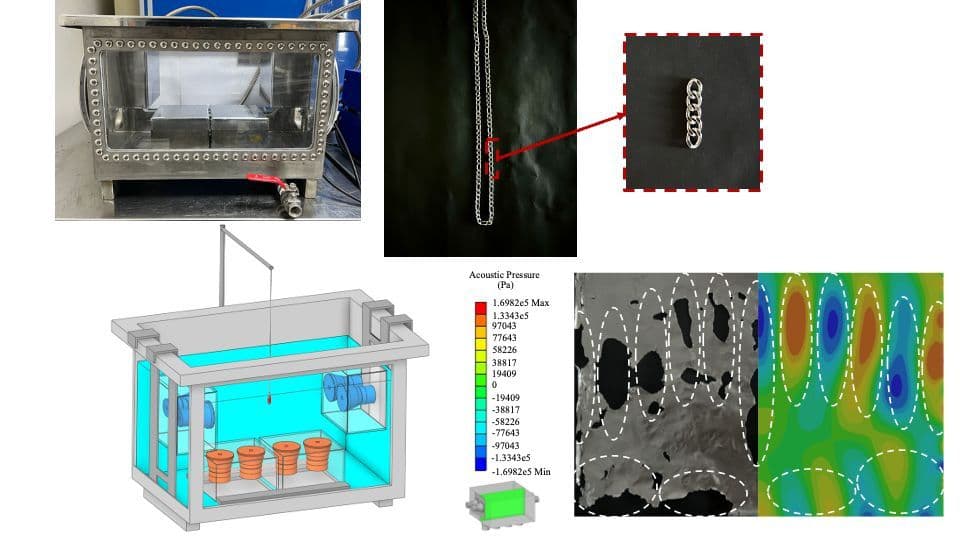
This research aims to improve the efficacy of ultrasonic cleaning tanks by using Harmonic Response Analysis in ANSYS to simulate acoustic pressure distribution. The study identifies optimal conditions to prevent cleaning failures and object damage in industrial processes.
Ultrasonic cleaning tanks are widely used in factories, but issues with uneven acoustic pressure distribution and unsuitable cavitation have led to cleaning failures and object damage. To improve the tank's efficacy, this research utilizes:
- Harmonic Response Analysis in ANSYS to simulate acoustic pressure intensity and distribution patterns.
- Optimization of factors including object positioning, power, ultrasonic frequency, and transducer placement.
- Validation of simulation results through foil corrosion tests and ultrasonic power probes.
Findings indicate that cavitation intensity increases with temperature, and higher ultrasonic frequencies lead to more even acoustic pressure dispersion.
Objective
The objectives are to simulate cavitation within the ultrasonic tank, study the effects of various operational conditions, and determine the optimal parameters for cleaning efficiency.
- To simulate the occurrence of cavitation within the ultrasonic cleaning tank.
- To study the effects of cavitation based on object positioning, frequency, and transducer installation location.
- To determine the optimal conditions for object placement, transducer frequency, and transducer installation positioning.