




Innovation Owner
Miss PONPREEYA SANGUANSANG
Student
Details
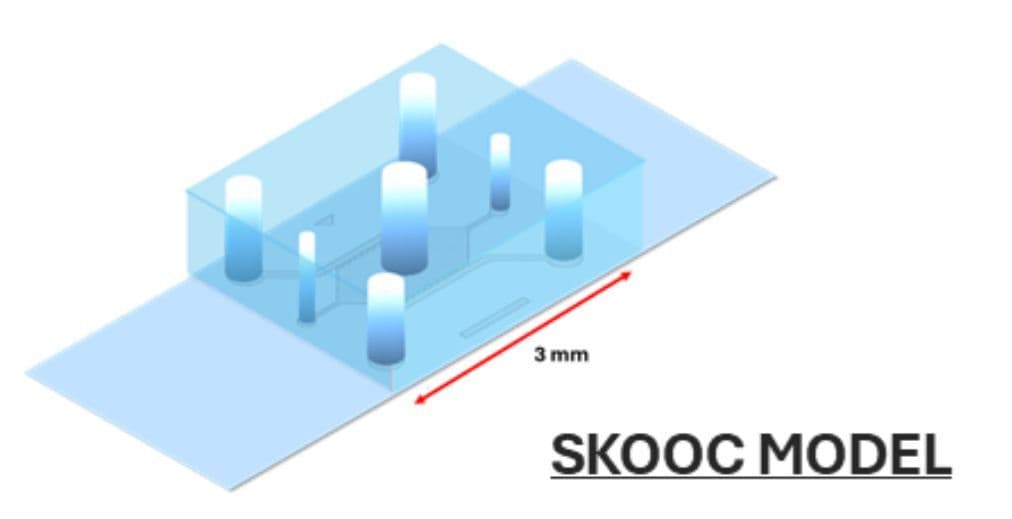
The development of skin-on-a-chip models addresses the limitations of traditional 2D cell culture by utilizing microfluidic technology to create realistic 3D skin structures. This approach mimics both the epidermis and dermis, as well as physiological fluid flow.
The development of skin-on-a-chip models plays a crucial role in research for drug and cosmetic development. Traditional approaches often utilize two-dimensional (2D) methods that rely on culturing cells on flat surfaces, resulting in a lack of complexity in skin structure and realistic cell interactions. Moreover, traditional methods have limitations in mimicking fluid flow and nutrient circulation, which affects the accuracy of pharmaceutical testing and the prediction of drug effects. This has led to the advancement of three-dimensional (3D) skin models using new microfluidic technology, enhancing the realism of skin structure by replicating both the epidermis and dermis layers, as well as simulating fluid flow similar to physiological conditions in the human body. The design of 3D systems allows for more realistic cell arrangement and interactions, enabling better simulation of skin functions and increasing the accuracy in evaluating the effects of various substances on cell responses, including absorption, inflammation, and wound healing.
Therefore, the development of three-dimensional (3D) skin models not only addresses the limitations of traditional methods but also represents a significant step forward in creating models that can be effectively applied in drug testing and pharmaceutical product development.
Objective
The project aims to study the fabrication and design of microfluidic systems using soft lithography, investigate skin cell viability within the chip, and explore skin simulation using microfluidic technology.
- To study the fabrication and design of microfluidic systems using soft lithography processes.
- To study the viability of skin cells within the chip.
- To study skin simulation using microfluidic systems.